
Категории
Новый блог
How Do Edge Data Centers Benefit From Upgrading To A Smart Axial Flow Fan Array?
September 23 , 20261.Quick Answer
Edge data centers are becoming increasingly important as businesses move computing, storage, artificial intelligence, telecommunications, video processing, industrial control, and other digital services closer to users and connected devices. Unlike large centralized data centers, edge facilities are often deployed in smaller spaces where cooling capacity, floor area, power availability, maintenance access, and environmental conditions can be much more difficult to control.
Upgrading from conventional individual cooling fans to a smart Axial Flow Fan array can help edge data centers improve airflow distribution, thermal stability, energy efficiency, redundancy, remote monitoring, and maintenance flexibility. Instead of treating every fan as an isolated component, a smart fan array can operate multiple fans as one coordinated cooling system.
The key benefit is not simply producing more airflow. The real advantage is the ability to match airflow with the actual thermal demand of different equipment zones.
Modern data center thermal management increasingly emphasizes airflow optimization, containment, variable-speed control, and monitoring. ASHRAE notes that variable-speed forced-convection cooling and intelligent fan-speed control can adjust airflow according to workload and thermal conditions. It also recommends granular temperature monitoring and airflow optimization as important parts of efficient thermal management.
For edge data centers, this approach is particularly valuable because the cooling system often has to operate in compact spaces with changing workloads and limited opportunities for maintenance.
A properly designed smart fan array can therefore provide five major advantages.
First, it distributes cooling airflow more evenly.
Second, it adjusts cooling output according to real-time thermal demand.
Third, it creates redundancy so that one failed fan does not necessarily stop the entire cooling system.
Fourth, it can reduce unnecessary fan power during periods of low computing demand.
Fifth, it provides a scalable architecture that can be adapted when the edge computing load increases.
2.Key Takeaways
The first important point is that edge data center cooling is fundamentally an airflow management problem as well as a heat removal problem.
A fan that produces high airflow under free-air conditions may not provide the expected performance after installation because racks, filters, grilles, heat exchangers, ducts, cables, and other structural components create system resistance.
The second point is that multiple smaller fans can provide operational flexibility that a single large fan cannot easily provide. A fan array allows different numbers of fans to operate at different speeds according to the cooling requirement.
The third point is that redundancy is especially valuable at remote edge sites. When technicians are not continuously present, the cooling system needs to tolerate individual component failures and provide enough warning for maintenance teams to respond.
The fourth point is that intelligent control should be connected to temperature sensors, fan feedback, equipment controllers, BMS, or DCIM whenever possible. Without feedback, a fan array may simply become a group of conventional fans operating at fixed speeds.
The fifth point is that fan selection should consider airflow, static pressure, speed, noise, power consumption, bearing structure, operating temperature, expected service life, control interface, protection level, and installation dimensions rather than focusing on CFM alone.
3.Why Edge Data Centers Have More Difficult Cooling Requirements
Edge data centers are generally deployed closer to users, devices, industrial equipment, communication networks, or local applications. This makes them useful for applications that require low latency or local processing, but their physical environments can be very different from those of purpose-built hyperscale data centers.
An edge installation may be located inside a telecommunications room, office building, retail facility, manufacturing site, transportation facility, hospital, warehouse, or outdoor enclosure.
This creates several thermal challenges.
The first challenge is limited physical space.
A conventional data center can dedicate substantial floor and ceiling space to cooling equipment, airflow channels, raised floors, containment systems, and service areas. An edge installation may need to fit computing equipment, UPS systems, power distribution, networking equipment, batteries, monitoring devices, and cooling components into a compact cabinet or room.
The second challenge is variable heat generation.
Edge computing workloads can change significantly throughout the day. A communication gateway may experience relatively low demand during one period and much higher demand during another. AI inference, video analytics, industrial vision, or real-time processing can also create sudden increases in computational load.
If cooling fans always operate at maximum speed, energy is wasted during low-load periods. If they operate too slowly during high-load periods, hot spots may develop.
The third challenge is remote maintenance.
Large data centers usually have dedicated engineering teams and carefully planned maintenance procedures. Remote edge sites may be geographically dispersed. A cooling failure may therefore remain unnoticed for longer if the system lacks remote monitoring.
The fourth challenge is airflow obstruction.
Dense equipment racks can create resistance to airflow. Cable bundles, filters, protective grilles, heat exchangers, and narrow air passages can further increase pressure requirements.
The fifth challenge is environmental variation.
An edge enclosure may experience changing ambient temperatures, dust, humidity, vibration, or other environmental factors depending on its location.
For these reasons, cooling should be designed as an integrated system rather than as a collection of unrelated fans.
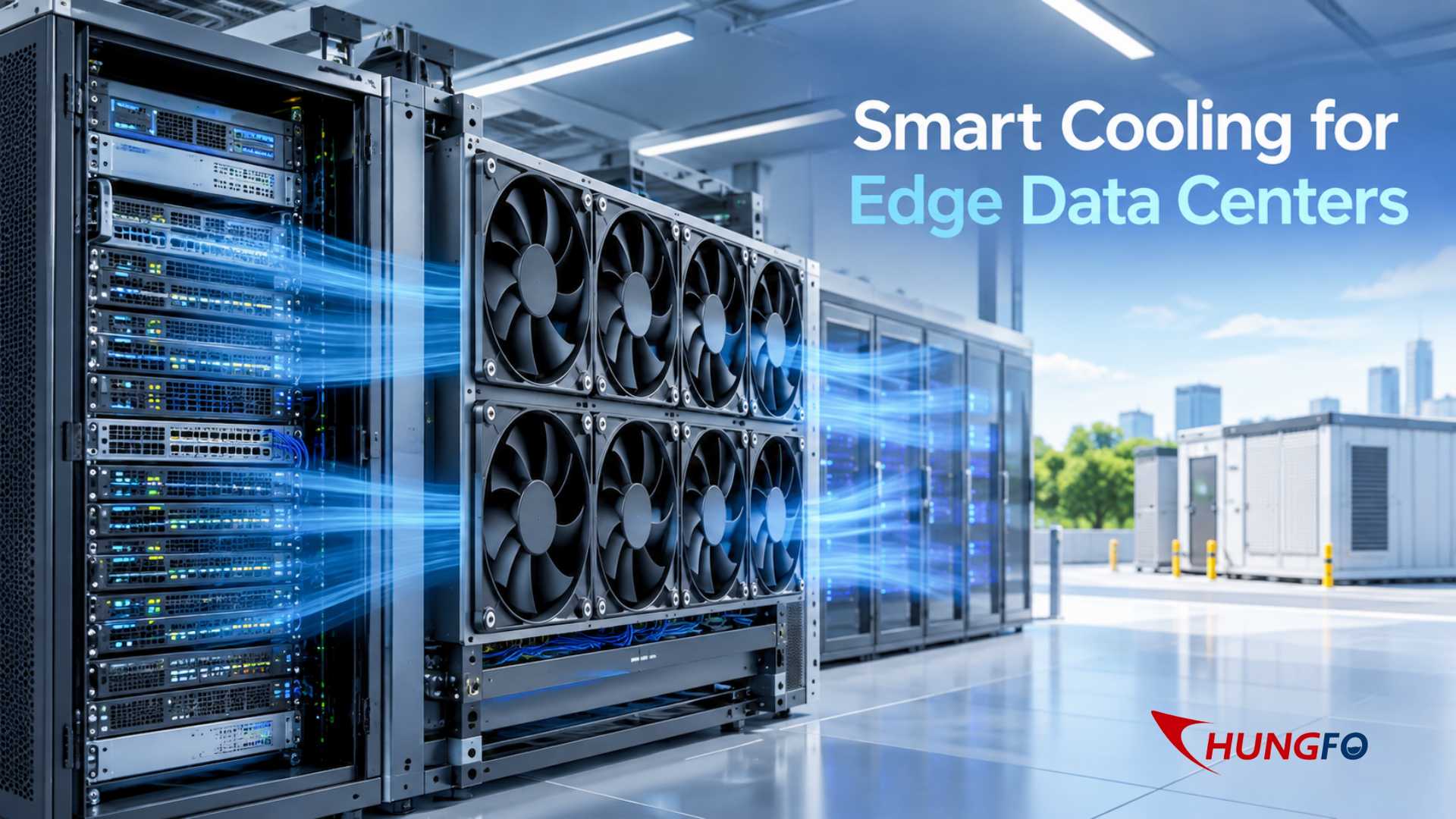
3.What Is A Smart Axial Flow Fan Array?
A smart Axial Flow Fan array is a cooling architecture in which multiple axial-flow fans operate together under a coordinated control strategy.
Instead of using one large fan to provide all required airflow, several fans are arranged in parallel or in strategically distributed positions.
The word “smart” refers to the control and monitoring capability surrounding the fan array.
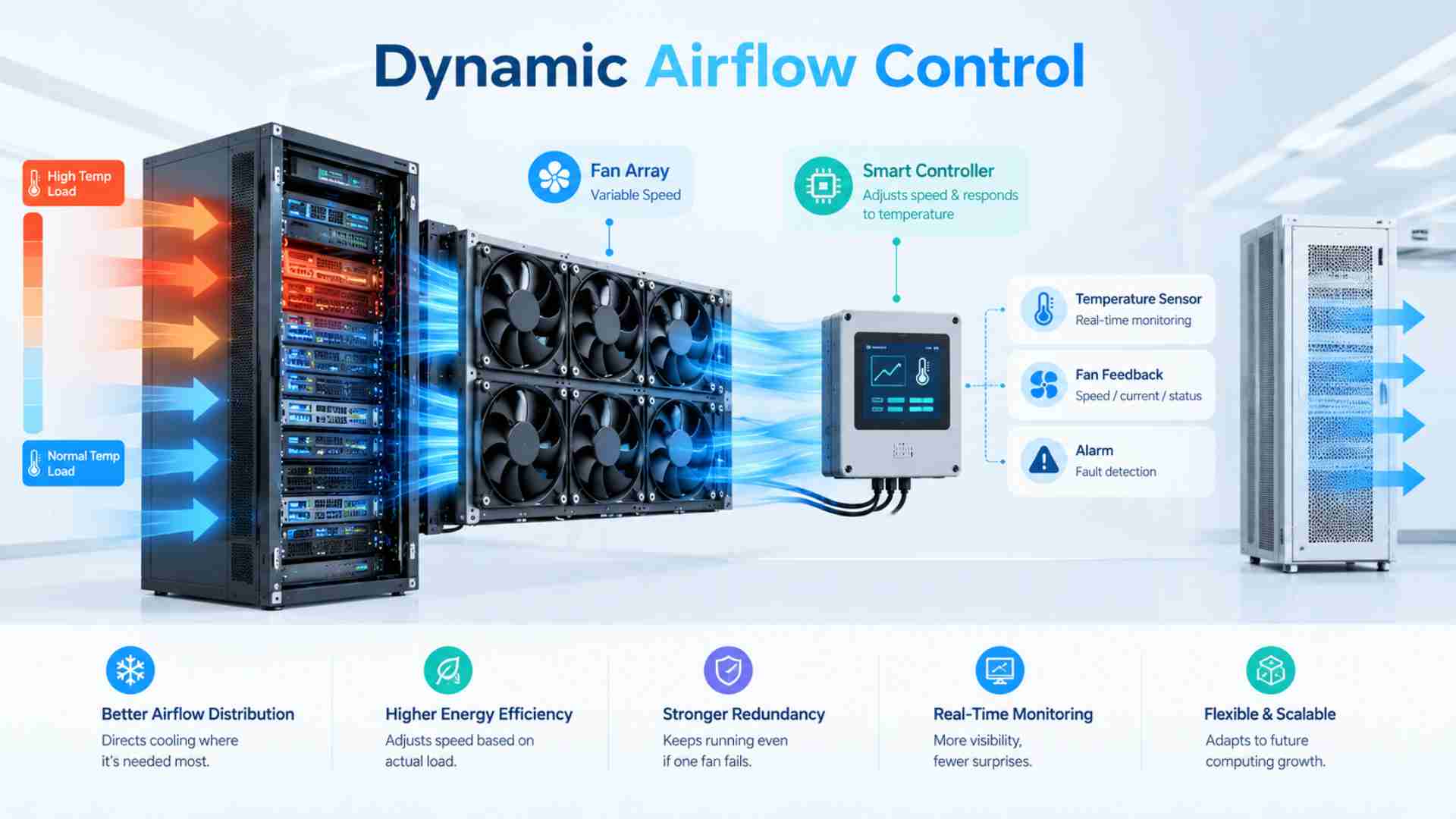
A smart system may monitor temperature, fan speed, current, voltage, operating status, alarm signals, or other parameters. The controller can then adjust the operating speed of individual fans or groups of fans.
For example, if the temperature at the upper section of a rack rises while the lower section remains relatively cool, the controller can increase airflow in the affected zone rather than increasing every fan to maximum speed.
This approach is consistent with the broader principle of fan-zone control described by ASHRAE, where fans serving less thermally stressed areas can operate at lower speeds than fans serving more heavily loaded areas.
A fan array can therefore be viewed as a modular thermal management platform.
Each individual fan represents one airflow module.
The controller represents the intelligence layer.
Temperature and airflow sensors provide feedback.
The enclosure, rack, duct, grille, heat exchanger, or cooling channel represents the airflow path.
Together, these components form a closed-loop thermal management system.
4.Why A Fan Array Can Be Better Than One Large Fan
A single large fan can provide substantial airflow, but it creates a single-point dependency.
If that fan fails, airflow may drop dramatically.
A fan array distributes the cooling function across multiple units.
For example, a system designed with six fans may not require all six fans to operate continuously at maximum speed. Under moderate thermal conditions, four or five fans may be sufficient. During high thermal loads, additional fans can start automatically.
This creates operational flexibility.
It also makes maintenance easier.
If one fan develops a fault, the controller can detect the failure and maintain operation with the remaining fans, provided the system has sufficient reserve capacity.
This concept is especially useful for edge sites where immediate physical intervention may not be possible.
Another advantage is installation flexibility.
Instead of designing one large airflow opening, engineers can distribute several smaller airflow modules around the equipment.
This can make it easier to address local hot spots.
The fan array can also be designed in different configurations depending on the enclosure.
Fans can be installed at the front and rear of an enclosure, arranged above server modules, integrated into cooling cabinets, positioned near heat exchangers, or used as part of a contained airflow channel.
The correct configuration depends on system resistance and airflow requirements.
5.How Smart Fan Speed Control Improves Energy Efficiency
Fan energy consumption is one of the most important reasons to consider intelligent speed control.
For a conventional fixed-speed cooling system, the fan may operate at full speed even when the computing load is relatively low.
That means the system continues consuming the same fan power even though the cooling requirement has decreased.
A variable-speed fan array can instead respond to actual thermal demand.
Suppose a rack operates at a relatively low computational load during the night. Temperature sensors detect stable inlet temperatures and low heat generation.
The controller can reduce the speed of the fan array.
When the workload increases, temperatures begin to rise.
The controller increases fan speed.
If the thermal load becomes concentrated in one section, the system can increase airflow in that section rather than increasing the entire system equally.
This can improve the relationship between cooling output and energy consumption.
ASHRAE specifically identifies airflow tuning, variable-speed control, and matching fan operation to actual IT load as important strategies for improving data center thermal efficiency.
This is particularly meaningful for edge sites because many edge installations have limited power budgets.
Reducing unnecessary fan speed can also help reduce acoustic output, mechanical stress, and operating hours at high speed.
6.Improving Airflow Distribution Inside Compact Edge Enclosures
Airflow distribution is often more important than maximum free-air airflow.
Imagine an enclosure containing several computing modules.
The lower section may receive adequate cooling while the upper section experiences insufficient airflow.
A single centrally located fan may not correct this imbalance effectively.
A fan array provides more options.
Fans can be positioned according to the thermal map of the enclosure.
If the upper section generates more heat, additional airflow can be directed there.
If the center section has higher pressure resistance, the fan selection can be adjusted to provide suitable static pressure.
This is why engineers should evaluate the complete airflow path.
The relevant question is not simply:
“How much airflow can the fan produce?”
A better question is:
“How much useful airflow reaches the target equipment at the required pressure?”
This distinction is critical in compact data center systems.
ASHRAE guidance also emphasizes airflow paths, equipment airflow characteristics, pressure drops, and the importance of accurate airflow modeling.
7.Static Pressure Matters In Edge Data Center Cooling
Static pressure is often underestimated during fan selection.
A fan may have an impressive free-air airflow rating, but actual airflow can fall substantially when the fan must overcome resistance.
Typical sources of resistance include filters, protective grilles, heat exchangers, narrow passages, server components, duct transitions, and containment structures.
Therefore, fan selection should be based on a system curve rather than a single airflow number.
The engineering team should first estimate the required airflow.
Then it should determine the expected system resistance.
The selected fan should provide the required airflow at the actual operating pressure.
A smart fan array can further improve this system because several fans can share the airflow demand.
However, adding more fans does not automatically guarantee better performance.
Fan spacing, inlet conditions, outlet conditions, turbulence, system resistance, and control logic all affect the final result.
8.The Role Of Small 12V DC Fan Modules
Compact edge computing equipment often contains smaller electronic modules that require localized cooling.
This is where a small 12v dc fan can be useful.
A small DC fan can provide localized airflow for networking modules, control boards, compact power supplies, communication equipment, storage modules, or auxiliary electronics.
Its major advantage is flexibility.
A compact DC fan can be installed where a larger fan cannot fit.
It can also operate as part of a distributed cooling strategy.
For example, a rack may use a larger fan array for overall cabinet airflow while smaller DC fans provide localized cooling around individual components.
This creates two thermal management layers.
The first layer manages overall cabinet airflow.
The second layer addresses local heat sources.
The combination can be especially useful when the equipment contains several components with very different thermal requirements.
For DC-powered edge equipment, the use of compact DC fans can also simplify integration because the fan voltage can be matched to the system power architecture.
9.Where A Small Blower Fan 12V Can Be More Suitable
Axial fans are excellent when the primary requirement is to move a large volume of air through a relatively open airflow path.
However, some compact edge applications have more complicated airflow paths.
A small blower fan 12v can be useful when air needs to be directed through a narrow channel or when higher pressure is required for a specific localized airflow path.
For example, a blower may be used to move air through a narrow electronics compartment, heat exchanger channel, filter structure, or duct.
This means axial fans and blower fans do not necessarily compete with each other.
They can perform different functions within the same cooling architecture.
A practical edge cooling system might use axial fans for cabinet-level airflow and compact blower fans for component-level cooling.
The correct choice depends on airflow, pressure, available space, noise requirements, and the physical design of the air channel.
10.Redundancy And Reliability
Reliability is one of the strongest arguments for a fan array.
A traditional cooling system based on one fan may have a relatively simple architecture, but the fan becomes a critical component.
If it fails, cooling capacity can be significantly reduced.
A multi-fan architecture distributes the risk.
Suppose an array contains several independent fan modules.
If one module stops working, the remaining fans can continue operating.
The controller can generate an alarm and notify the maintenance team.
If the system has enough reserve capacity, the edge site may continue operating until the failed module can be replaced.
This approach is particularly useful in remote installations.
The goal is not necessarily to make every fan operate forever.
The goal is to prevent a single component failure from immediately becoming a system-level thermal failure.
11.Predictive Maintenance Through Fan Monitoring
A smart fan array can provide much more information than simple on and off control.
Depending on the fan and control architecture, monitoring can include speed feedback, current consumption, temperature, alarm status, voltage, locked-rotor conditions, or communication status.
These parameters can help identify abnormal operating conditions.
For example, a fan that gradually requires higher current or produces abnormal speed feedback may indicate developing mechanical or electrical problems.
The monitoring system can flag the problem before complete failure.
This allows maintenance teams to plan replacement during scheduled service rather than responding only after a thermal alarm occurs.
For remote edge sites, this difference can be significant.
A technician may need to travel a considerable distance to reach a site.
Early warning can therefore reduce emergency intervention.
12.Remote Monitoring And Smart Control
Modern edge data centers increasingly require remote visibility.
A smart fan system can be connected to a local controller, BMS, DCIM, PLC, or other monitoring architecture depending on the application.
Temperature sensors can provide real-time information.
Fan controllers can adjust speed.
Alarm outputs can notify operators.
Historical data can be used to analyze thermal trends.
This creates a more intelligent cooling system.
Instead of asking whether the fan is running, operators can ask more useful questions.
Is the airflow sufficient?
Is one fan running significantly faster than the others?
Is one area consistently hotter?
Has the required fan speed increased over time?
Is the system approaching its cooling limit?
These questions can support better maintenance and energy management.
13.How A Smart Fan Array Helps With Hot Spots
Hot spots are one of the most important thermal risks in compact computing environments.
A rack can have an acceptable average temperature while still containing individual components that experience excessive temperatures.
This is why rack-level and equipment-level monitoring is valuable.
ASHRAE recommends granular monitoring at rack inlets rather than relying only on room-level measurements.
A smart fan array can respond to these measurements.
If one temperature sensor reports an increasing temperature, the controller can increase airflow in the corresponding zone.
This is more precise than increasing airflow everywhere.
The result is a more targeted cooling strategy.
14.Smart Fan Arrays And Space Constraints
Space is one of the defining characteristics of edge data centers.
Traditional cooling equipment can require valuable floor area.
A modular fan array can be integrated into racks, cabinets, ceiling systems, wall systems, or compact cooling modules.
Current edge cooling solutions increasingly emphasize compact designs and cooling equipment integrated close to the IT load. For example, Vertiv describes dedicated cooling for edge environments and solutions that integrate cooling into or around rack-level infrastructure.
This trend supports the idea that cooling should be designed around the physical constraints of the edge environment.
15.Comparing Conventional Fans With Smart Fan Arrays
Feature Conventional:Single Fan,Smart Fan Array.
Airflow control:Usually simple,Multi-zone and variable-speed control.
Redundancy: Limited,Multiple fan modules.
Failure impact:Potentially high,Can be distributed.
Energy optimization:Limited,Dynamic.
Hot-spot response:Limited,More targeted.
Remote monitoring:Optional,Easier to integrate.
Maintenance:Reactive,Can support predictive maintenance.
Scalability:Limited by single unit,Modular.
Installation flexibility:Moderate,High.
Suitable for changing loads:Less flexible,Highly adaptable.
The table does not mean that a fan array is automatically better for every application. The architecture should be selected according to the required airflow, pressure, available space, control requirements, cost, reliability target, and environmental conditions.
16.How To Design A Smart Axial Flow Fan Array
The first step is to calculate the heat load.
The approximate cooling requirement can be estimated from the electrical power converted into heat.
For example, if an edge cabinet contains equipment consuming 5 kW of electrical power, a large portion of that power ultimately becomes heat that must be removed.
The next step is to determine the required temperature rise.
Airflow requirements can then be estimated from the heat load and allowable temperature difference.
However, this calculation should not be treated as the final fan selection.
Engineers must also evaluate pressure losses.
The airflow path should include filters, grilles, ducts, heat exchangers, equipment resistance, and other components.
Once the operating point is determined, the fan performance curve can be evaluated.
The next step is to decide the number of fan modules.
More fans can provide redundancy and control flexibility, but excessive fan quantity can increase cost, wiring complexity, and system integration requirements.
The control architecture should then be defined.
The system may use temperature feedback, speed feedback, PWM control, voltage control, communication interfaces, or other methods depending on the application.
17.1 Fan Quantity
The number of fans should be based on the required airflow and redundancy strategy.
A six-fan system, for example, could be designed so that five fans provide the normal operating requirement while the sixth provides reserve capacity.
The exact configuration depends on the system.
17.2 Fan Speed
The fan should not necessarily run at maximum speed continuously.
Variable-speed operation allows the cooling output to follow thermal demand.
17.3 Airflow Direction
The direction of airflow must match the equipment design.
Most modern IT equipment uses front-to-rear airflow, although some telecommunications equipment and network switches may use different airflow patterns.
17.4 Noise
Edge equipment can sometimes be installed in offices, commercial buildings, or other occupied environments.
Fan speed, blade design, bearing structure, vibration, mounting method, and airflow turbulence can all influence acoustic performance.
17.5 Protection
For installations exposed to dust, humidity, or industrial environments, the fan may require an appropriate protection design.
The required protection level should be determined according to the actual installation environment.
18.Practical Application Example
Consider a compact edge computing cabinet installed in a remote communication facility.
The cabinet contains networking equipment, computing modules, a power supply system, and monitoring equipment.
The total IT load changes throughout the day.
During low traffic periods, the equipment generates relatively little heat.
During peak traffic, the thermal load increases.
A conventional cooling system may operate several fans at a fixed speed.
This approach is simple but may consume unnecessary power during low-load periods.
A smart fan array can divide the cabinet into thermal zones.
Temperature sensors are installed near critical equipment.
During low load, only a portion of the fan array operates at reduced speed.
As the temperature rises, additional fans start automatically.
If one fan reports a fault, the controller increases the output of the remaining fans and generates an alarm.
When the load decreases, the controller gradually reduces airflow.
This example demonstrates the main value of intelligent airflow management.
The system does not simply provide maximum airflow.
It provides the airflow required by the equipment at the time it is required.
19.Example Product Configuration From China Chungfo Fan
China Chungfo Fan develops and manufactures DC and AC fans, blowers, cross-flow fans, axial fans, frameless fans, and DC and AC motors for different industrial and commercial applications.
For edge computing and electronic cooling applications, the appropriate fan should be selected according to the actual system requirements rather than by size alone.
A compact DC fan can be considered for localized cooling inside a network enclosure.
A higher-airflow axial fan can be considered for cabinet-level airflow.
A compact blower can be considered where the airflow path requires higher pressure or directional air delivery.
China Chungfo Fan operates an integrated manufacturing structure covering product design and development, mold development, injection molding, SMT, finished-product assembly, sales, and after-sales support.
Its production capabilities include automated SMT lines and testing equipment such as dynamic balance testing equipment, salt spray testing equipment, wind tunnel and pressure testing equipment, high and low temperature chambers, noise testing facilities, RoHS testing equipment, Gauss meters, and constant temperature and humidity testing equipment.
The company also has experience in customized fan requirements, including different voltages, currents, speeds, airflow specifications, wires, connectors, and structural configurations.
For an edge data center cooling project, this type of customization can be useful because the available installation space and airflow path can vary significantly from one enclosure to another.
20.Product Selection Parameters For Edge Data Center Fans
When selecting a fan for an edge computing application, engineers should evaluate several parameters together.
Airflow is the first parameter.
It indicates the volume of air the fan can move.
Static pressure is the second parameter.
It indicates the fan's ability to maintain airflow against resistance.
Voltage is another important parameter.
Compact systems may use 12 V, 24 V, or other DC power architectures.
Current consumption should also be evaluated because it directly affects electrical design and operating power.
Rotational speed is useful for understanding airflow potential, but RPM alone cannot determine actual cooling performance.
Noise is important when edge equipment is installed near people.
Bearing type can influence service life, noise, and operating characteristics.
Operating temperature should match the intended environment.
Protection requirements should also be evaluated.
Finally, control and feedback functions should be considered if the fan will become part of a smart array.
21.Why Small DC Fans Can Complement Larger Cooling Fans
A large cooling system and a small local cooling fan do not necessarily serve the same purpose.
The larger fan handles overall airflow.
The smaller fan handles localized thermal problems.
For example, a compact network controller may require additional airflow even when the main cabinet airflow is adequate.
A small DC fan can provide this localized airflow.
This layered strategy can reduce the need to overcool the entire enclosure simply because one small component requires additional cooling.
It can therefore support more efficient system design.
22.Maintenance Advantages Of Modular Fan Arrays
Maintenance is another important consideration.
A modular fan array can allow individual fan modules to be replaced rather than replacing an entire cooling assembly.
This can simplify spare-parts management.
For a company operating many geographically distributed edge sites, standardized fan modules can also make maintenance procedures more consistent.
Technicians can replace a failed module and return the site to normal operation more quickly.
The exact maintenance strategy depends on the mechanical design and whether the fan array supports hot-swappable replacement.
23.Scalability For Future Edge Computing Loads
Edge computing workloads are not static.
A cabinet that is adequately cooled today may require more cooling capacity after additional servers, communication equipment, storage, or AI processing modules are installed.
A modular fan array provides a potential path for scaling.
Additional fan modules can sometimes be added during system redesign.
Alternatively, existing fans can operate at higher speeds if sufficient capacity exists.
This modularity can be valuable for infrastructure planners who want to avoid completely replacing a cooling system whenever IT load changes.
24.The Relationship Between Cooling Efficiency And Equipment Reliability
Cooling efficiency should not be evaluated only by energy consumption.
The primary objective is maintaining equipment within its required operating conditions.
If airflow is too low, component temperatures can rise.
If airflow is excessive, energy consumption and acoustic output may increase unnecessarily.
The ideal system balances thermal safety and energy efficiency.
This is why intelligent control is important.
The fan array should continuously adapt to actual operating conditions.
ASHRAE describes thermal management as a balance between component temperatures, equipment performance, and power consumption.
25.Common Mistakes When Upgrading A Fan Array
One common mistake is selecting fans only according to free-air CFM.
Another is ignoring static pressure.
A third is installing more fans without analyzing airflow distribution.
A fourth is operating every fan at maximum speed.
A fifth is failing to provide sufficient sensor feedback.
A sixth is ignoring airflow direction.
A seventh is overlooking noise and vibration.
An eighth is failing to plan for fan failure.
A ninth is choosing a fan that fits mechanically but does not meet the required operating point.
A tenth is treating the cooling system as an isolated component rather than part of the complete thermal architecture.
26.How To Evaluate Whether An Upgrade Is Necessary
An edge data center should consider upgrading its fan architecture when one or more of the following conditions occur.
Equipment inlet temperatures are becoming unstable.
Hot spots appear repeatedly.
Fans operate at maximum speed for long periods.
Cooling energy consumption is increasing.
The existing cooling system has a single point of failure.
Maintenance requires frequent manual inspection.
Remote monitoring is insufficient.
The computing load is increasing.
The enclosure has limited space.
The current airflow system cannot be easily expanded.
If several of these conditions are present, a smart fan array may provide a more flexible cooling architecture.
FAQ
27.1 What Is A Smart Axial Flow Fan Array?
A smart axial flow fan array is a group of axial-flow fans operating under coordinated control. The system can use temperature, speed, current, or other feedback to adjust fan operation according to cooling demand.
27.2 Why Use Multiple Fans Instead Of One Large Fan?
Multiple fans can provide greater redundancy, more flexible airflow control, easier zoning, and potentially easier maintenance. The correct choice depends on system airflow, pressure, space, cost, and reliability requirements.
27.3 Can A Fan Array Reduce Energy Consumption?
It can. When combined with variable-speed control and appropriate temperature feedback, the system can reduce airflow during periods of low thermal demand instead of operating every fan continuously at maximum speed.
27.4 Are Small DC Fans Useful In Edge Data Centers?
Yes. Compact DC fans can provide localized cooling for networking equipment, control electronics, power modules, storage devices, and other components where cabinet-level airflow is not sufficient.
27.5 When Should A Blower Be Used Instead Of An Axial Fan?
A blower can be considered when the application requires more directional airflow or higher pressure through a narrow or restrictive airflow path. An axial fan is generally more suitable for moving larger volumes of air through a relatively open path.
27.6 Does A Fan Array Need Temperature Sensors?
A smart array benefits significantly from temperature feedback. Sensors allow the control system to respond to actual thermal conditions instead of relying only on fixed-speed operation.
27.7 How Does Fan Redundancy Improve Reliability?
If one fan fails, other fans can continue operating if sufficient reserve capacity is designed into the system. The controller can also generate an alarm so that maintenance personnel can replace the failed unit.
27.8 What Voltage Should Be Used For Edge Data Center Fans?
There is no universal voltage requirement. The correct voltage depends on the electrical architecture of the equipment. Common DC configurations include 12 V and 24 V, but the final selection should follow the system power design.
27.9 What Is More Important, Airflow Or Static Pressure?
Both are important. The fan must provide the required airflow at the actual system pressure. Selecting a fan according to free-air airflow alone can result in insufficient real-world cooling.
27.10 Can China Chungfo Fan Customize Cooling Fans For Edge Applications?
Yes. China Chungfo Fan can support customized fan requirements involving dimensions, voltage, current, speed, airflow, wires, connectors, and other structural or electrical specifications, subject to the project requirements.
Final Conclusion
The cooling requirements of edge data centers are changing as computing equipment becomes denser, workloads become more dynamic, and installations become smaller and more geographically distributed.
A conventional fixed-speed fan can still be suitable for simple applications, but more demanding edge environments can benefit from a coordinated fan-array architecture.
The value of a smart Axial Flow Fan array is not simply that it contains more fans.
Its real value comes from combining multiple airflow modules with intelligent control, thermal monitoring, redundancy, and flexible airflow distribution.
When correctly designed, the system can provide airflow where it is needed, reduce unnecessary operation when cooling demand is low, respond to hot spots, tolerate individual fan failures, and simplify maintenance.
Compact DC fans can support localized cooling, while blower solutions can address restricted airflow paths that require additional pressure or directional airflow.
For edge data centers, the most effective cooling strategy is therefore not necessarily the system with the largest fan or the highest theoretical airflow.
It is the system that provides the right airflow, at the right pressure, in the right location, at the right time.
As edge computing continues to expand into telecommunications, industrial automation, retail, transportation, healthcare, smart manufacturing, and other distributed applications, intelligent thermal management will become increasingly important.
A carefully engineered fan array can provide a practical bridge between traditional air cooling and more advanced intelligent thermal management.
For manufacturers and system integrators, the key is to evaluate the complete airflow path, thermal load, control strategy, redundancy requirements, environmental conditions, and long-term maintenance plan before selecting the final fan architecture.
That approach can help create edge cooling systems that are more adaptable, maintainable, and aligned with the actual requirements of modern distributed computing infrastructure.