Категории
Новый блог
Как защитить уличный вентилятор охлаждения воздуха от разрушения водонепроницаемого уплотнения IP68?
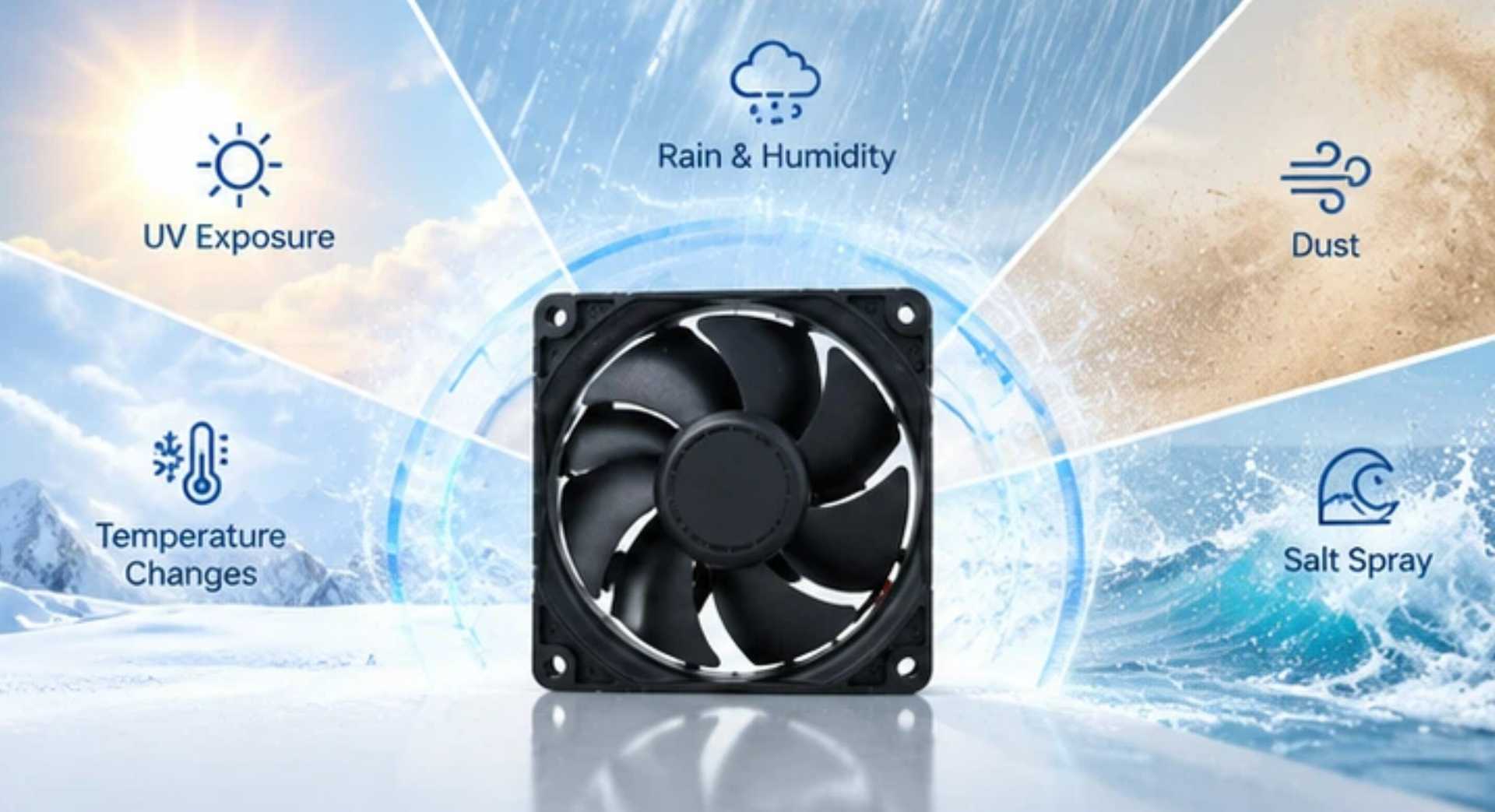
September 07 , 2026Вентиляторы наружного воздушного охлаждения все чаще используются в оборудовании, которое должно непрерывно работать в условиях дождя, влажности, пыли, перепадов температуры, солевого тумана и других сложных условий окружающей среды. Телекоммуникационные шкафы, наружные источники питания, зарядное оборудование для электромобилей, солнечные инверторы, промышленные шкафы управления, холодильные системы, сельскохозяйственная техника, светодиодные дисплеи и многие другие системы зависят от принудительного воздушного потока для отвода тепла. Однако при установке этих систем на открытом воздухе эффективность охлаждения — это лишь одна из составляющих надежности. Способность вентилятора сохранять свою защиту от воды и пыли в течение многих лет может быть не менее важна.
АнВентилятор с классом защиты IP68Предназначен для обеспечения очень высокого уровня защиты от пыли и попадания воды. Однако рейтинг IP68 не следует интерпретировать как гарантию того, что система герметизации останется неизменной навсегда. Воздействие внешней среды приводит к постоянным механическим, термическим, химическим и экологическим нагрузкам. Со временем уплотнения могут терять эластичность, клеи стареть, точки ввода кабелей могут становиться уязвимыми, соединения корпуса могут изменять свои размеры, а конденсация может создавать влагу, даже если прямая дождевая вода не попадает внутрь оборудования.
Это означает, что для защиты наружного вентилятора воздушного охлаждения от разрушения водонепроницаемого уплотнения класса IP68 требуется комплексная стратегия обеспечения надежности, а не просто выбор вентилятора с маркировкой IP68.
Поэтому для производителей оборудования и инженеров наиболее важным вопросом является не только то, сможет ли вентилятор пройти испытание IP68 в новом состоянии, но и то, смогут ли его уплотнительная конструкция, материалы, электрические компоненты, подшипники, кабельные соединения и условия установки продолжать надежно работать в течение всего ожидаемого срока службы.
Что на самом деле означает IP68 для наружного вентилятора охлаждения?
Код IP используется для описания уровня защиты, обеспечиваемого корпусом от твердых предметов и воды. Первая цифра обозначает защиту от твердых частиц, а вторая — защиту от воды. IP68 означает высокий уровень защиты от пыли, а также защиту от погружения в воду при определенных условиях испытаний. Точные условия погружения, связанные с заявленным IP68, могут зависеть от заявленных производителем условий испытаний и применимых требований.
Это различие важно при выборе уличного вентилятора.
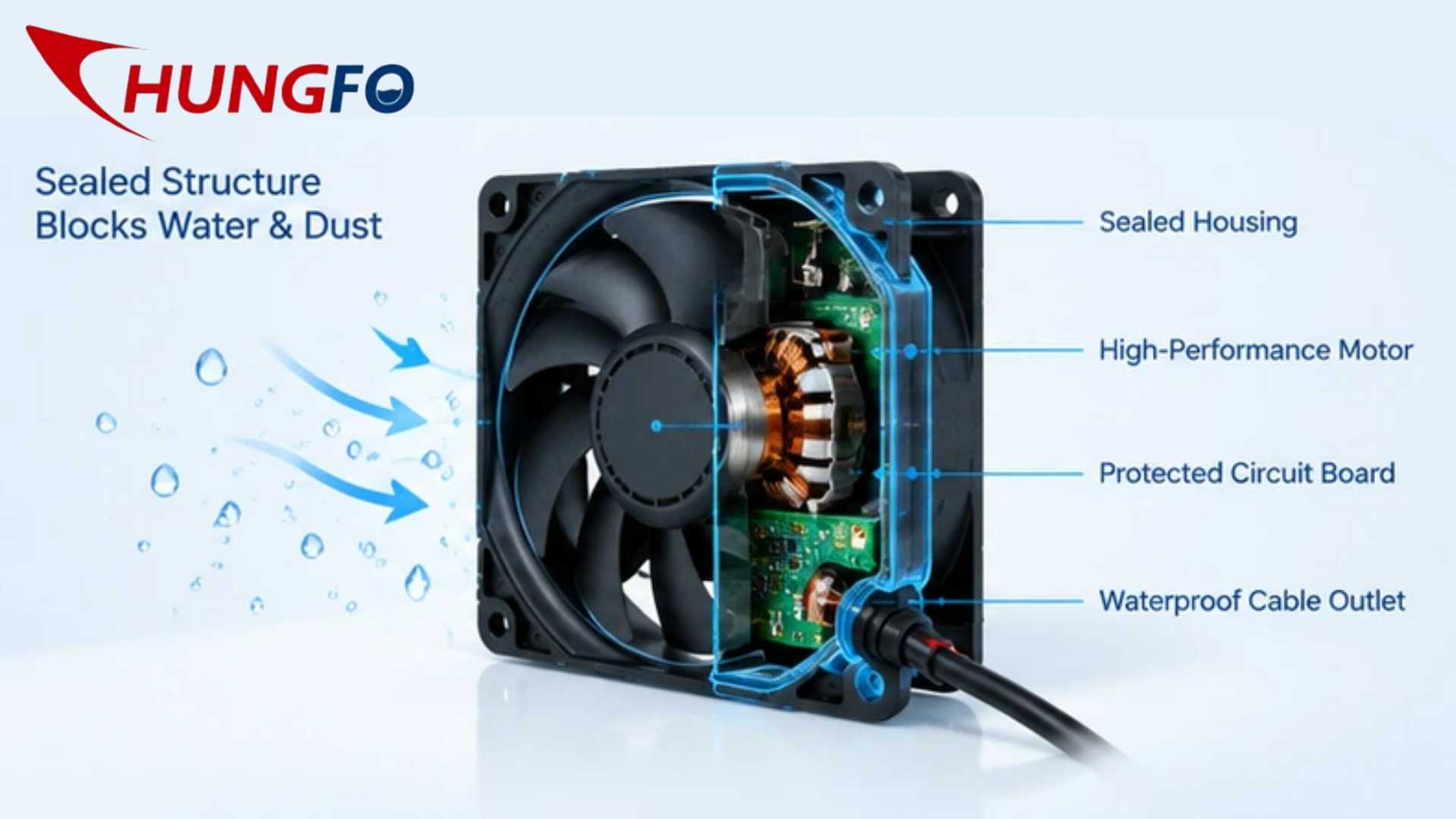
Вентилятор со степенью защиты IP68 — это не просто обычный вентилятор с резиновым кожухом. Для обеспечения надежной защиты производители обычно контролируют несколько потенциальных путей попадания воды. К ним могут относиться стыки корпуса, кабельные выходы, разъемы, конструкции двигателя, печатные платы, подшипниковые узлы и другие интерфейсы.
Хорошо спроектированный водонепроницаемый вентилятор может сочетать в себе герметичные корпуса, защиту смолой, конформные покрытия, водонепроницаемые кабельные выходы, специальные подшипники, коррозионностойкие материалы и тщательно контролируемые производственные процессы. Примеры из практики показывают, что заливка компаундом или герметизация могут использоваться для изоляции обмоток и печатных плат от внешней среды.
Однако уровень защиты, измеренный в ходе производственных испытаний, отражает конкретные условия в конкретный момент времени. Оборудование, используемое на открытом воздухе, подвергается многократным температурным циклам, вибрации, воздействию ультрафиолетового излучения, химическому загрязнению и механическим нагрузкам. Эти факторы могут постепенно изменять свойства уплотнительных материалов.
Именно поэтому долговременную защиту следует рассматривать как инженерную задачу системного уровня.
Почему водонепроницаемые уплотнения IP68 со временем могут изнашиваться?
Наиболее распространенная ошибка при проектировании систем наружного охлаждения — это ошибочное мнение, что гидроизоляция является постоянной характеристикой изделия. В действительности, на любую систему герметизации влияет окружающая среда.
Колебания температуры являются одним из важнейших факторов.
Вентилятор, работающий на открытом воздухе, может подвергаться воздействию холодных ночей, прямых солнечных лучей в течение дня, нагревающихся поверхностей оборудования, внезапных дождей и сезонных перепадов температуры. Пластиковые корпуса, резиновые уплотнения, клеи, металлические компоненты и полимерные материалы не обязательно расширяются и сжимаются с одинаковой скоростью.
Повторяющиеся расширения и сжатия могут создавать напряжение на границах раздела.
Если уплотнение становится тверже, мягче, сжимается, набухает или деформируется необратимо, его контактное давление может постепенно снижаться. Небольшое изменение может не сразу вызвать видимую протечку, но при многократном воздействии окружающей среды оно может создать путь для проникновения влаги.
Термоциклирование также важно, поскольку в наружных электронных корпусах могут возникать изменения давления. Когда внутренний воздух нагревается и расширяется, а затем охлаждается и сжимается, корпус может испытывать колебания давления. В течение длительных периодов эти циклы могут создавать нагрузку на слабые герметизирующие соединения. Инженерные исследования наружных герметичных корпусов выявили терморасширение и сжатие как потенциальные факторы, способствующие нарушению герметичности и проблемам с конденсацией.
Воздействие ультрафиолетового излучения также вызывает опасения.
Вентиляторы, установленные на открытом воздухе, могут подвергаться воздействию солнечного света в течение тысяч часов. В зависимости от материала, ультрафиолетовое излучение может способствовать изменению цвета, охрупчиванию, растрескиванию поверхности или потере механических свойств. Поэтому выбор материалов, подходящих для эксплуатации на открытом воздухе, важен, когда корпус вентилятора или уплотнительная конструкция непосредственно подвергаются воздействию солнечного света.
Влажность создает еще одну долгосрочную проблему.
Влажная среда не обязательно должна напрямую контактировать с водой, чтобы вызвать проблемы с надежностью. Влага может проникать через уязвимые соединения, разъемы, кабельные структуры или микроскопические дефекты. Высокая влажность также может ускорить коррозию металлических компонентов и электронных контактов.
Соляной туман может быть особенно агрессивным.
Наружное оборудование, устанавливаемое вблизи прибрежных зон, может подвергаться воздействию солевых частиц и влаги, содержащихся в воздухе. Загрязнение солью может ускорить коррозию металлических деталей, разъемов, крепежных элементов и электрических соединений. Поэтому производители вентиляторов часто предлагают специальные коррозионностойкие конструкции для применения в условиях воздействия солевого тумана и влаги.
Пыль может усугубить проблему.
Частицы пыли могут скапливаться вокруг уплотнений и механических соединений. Если пыль содержит абразивные или химически активные частицы, повторяющиеся движения или вибрация могут постепенно воздействовать на уплотнительную поверхность. При смешивании пыли с влагой могут образовываться отложения, которые сложнее удалить.
Как корпус вентилятора защищает водонепроницаемое уплотнение?
Корпус вентилятора является первой и основной линией защиты от загрязнения окружающей среды.
Надежный уличный вентилятор должен иметь корпус, который минимизирует ненужные отверстия и обеспечивает контролируемую герметизацию. Чем меньше неконтролируемых отверстий, тем проще обеспечить надежную защиту от внешних воздействий.
Конструкция соединительных элементов должна быть тщательно продумана.
Простое механическое соединение может не обеспечить достаточной долговременной защиты, если контактные поверхности, сжатие прокладки, допуски и способ крепления не контролируются должным образом. В зависимости от конструкции производители могут использовать прокладки, герметизирующие составы, заполнение смолой, заливку компаундом, литье под давлением или другие технологии.
Цель состоит не просто в том, чтобы затруднить открытие корпуса. Цель состоит в создании надежного барьера против воды, сохраняя при этом механическую целостность при вибрации и термических циклах.
Для применений, требующих особенно высокой степени защиты от воздействия окружающей среды, внутренние электронные компоненты могут быть также защищены с помощью покрытия или герметизации. В некоторых конструкциях вентиляторов со степенью защиты IP68 используются технологии на основе смол для изоляции чувствительных обмоток и печатных плат от воды и влаги.
Такой подход обеспечивает дополнительный уровень защиты.
Если во внешнем корпусе обнаруживается небольшой дефект, внутренняя герметизация может снизить вероятность попадания влаги на чувствительные электрические компоненты.
Почему кабельный вывод является критически важным местом для гидроизоляции?
Многие инженеры уделяют пристальное внимание корпусу вентилятора, но недооценивают кабельный вывод.
Кабель должен проходить из защищаемой внутренней зоны во внешнюю среду. Этот переход создает неизбежное взаимодействие.
Если кабельный ввод спроектирован неправильно, вода может просачиваться вдоль кабеля или через щели вокруг места ввода кабеля.
По этой причине в конструкциях водонепроницаемых вентиляторов часто используются литые кабельные выходы, герметики, кабельные сальники, водонепроницаемые разъемы или другие методы контролируемой герметизации.
Сам материал кабеля также имеет значение.
Кабели для наружного применения должны выдерживать перепады температуры, воздействие ультрафиолетового излучения, влаги, изгибы, вибрацию, а иногда и химические вещества. Кабель, хорошо работающий в помещении, не обязательно обеспечит такую же долговременную надежность на открытом воздухе.
Поэтому соединение между кабелем и вентилятором следует оценивать как часть всей системы гидроизоляции.
Использование высококачественного вентилятора со степенью защиты IP68 и незащищенным внешним разъемом может создать слабое место во всей системе. Вентилятор может обладать отличной защитой от воздействия окружающей среды, но конечный продукт может ею не обладать.
Как конденсация влияет на надежность вентилятора со степенью защиты IP68?
Гидроизоляция и образование конденсата — это две разные проблемы.
Прямое проникновение воды происходит, когда жидкая вода попадает внутрь через отверстие или поврежденное уплотнение. Конденсация происходит, когда влага, уже присутствующая в воздухе, превращается в жидкую воду из-за изменений температуры.
Это различие особенно важно для электронного оборудования, используемого на открытом воздухе.
В герметичном корпусе может содержаться влажный воздух. В дневное время внутренние компоненты нагревают воздух. Ночью оборудование охлаждается. Если внутренняя температура достигает точки росы, на более холодных поверхностях может конденсироваться вода.
Поэтому даже в хорошо герметичном корпусе может скапливаться внутренняя влага, если тепловые характеристики не контролируются должным образом.
Поэтому при проектировании наружных вентиляторных систем следует учитывать как защиту от попадания воды, так и управление влажностью.
В некоторых конструкциях корпусов для выравнивания давления и ограничения проникновения жидкой воды могут использоваться паропроницаемые мембраны. Выбор таких решений должен быть тщательным, поскольку любой дополнительный вентиляционный компонент может повлиять на общую защиту корпуса от воздействия окружающей среды. В рекомендациях для корпусов со степенью защиты IP67 и IP68 обычно подчеркивается важность выравнивания давления и предотвращения конденсации как составляющих долгосрочной надежности.
Как изменения температуры влияют на уплотнения вентилятора?
Колебания температуры зачастую наносят больший ущерб в долгосрочной перспективе, чем однократное воздействие высоких температур.
Представьте себе наружный охлаждающий вентилятор, работающий внутри электрического шкафа. Днём солнечное излучение повышает температуру шкафа. Вентилятор работает на высокой скорости, потому что внутренние электронные компоненты выделяют тепло. Ночью система быстро охлаждается.
Этот цикл может повторяться каждый день.
Корпус расширяется и сжимается. Уплотнительные материалы реагируют по-разному. Клеи испытывают напряжение. Оболочки кабелей незначительно изменяют свои размеры. Смазочные материалы внутри подшипников реагируют на температуру. Электронные компоненты также подвергаются многократным термическим нагрузкам.
Over thousands of cycles, small changes can accumulate.
This is why outdoor fan qualification should consider the actual operating temperature range rather than only the nominal room-temperature condition.
Selecting a fan designed for the expected temperature range can significantly improve reliability.
The thermal design should also consider the difference between ambient temperature and the temperature inside the equipment. A fan operating in a 40°C outdoor environment may be exposed to a considerably higher internal temperature if the enclosure receives solar radiation or contains high-power electronics.
A suitable outdoor fan therefore needs both environmental protection and thermal capability.
How Can Material Selection Reduce Seal Degradation?
Material selection is one of the most effective ways to improve long-term environmental reliability.
Different rubber, plastic, resin, adhesive, and cable materials behave differently under ultraviolet radiation, heat, humidity, chemicals, and salt exposure.
For sealing applications, engineers should consider compression set, temperature resistance, chemical compatibility, water resistance, and aging characteristics.
For fan housings, material selection should consider mechanical strength, dimensional stability, flame resistance, corrosion resistance, ultraviolet exposure, and operating temperature.
For bearings, moisture resistance and lubricant stability are important.
For cables, flexibility, insulation performance, temperature resistance, and environmental durability should be evaluated.
A waterproof fan should therefore be selected as a complete engineered system rather than simply according to its external appearance.
How Important Are Bearings In An Outdoor Cooling Fan?
The waterproof seal protects electrical components, but the bearing system determines how reliably the impeller can rotate.
Outdoor environments can accelerate lubricant degradation and corrosion if the bearing structure is not suitable for the application.
Water exposure can be particularly damaging to conventional bearing systems.
A bearing that performs well in a clean indoor cabinet may experience different conditions in an outdoor agricultural machine, coastal power system, or industrial enclosure.
For long-life outdoor operation, engineers should consider bearing construction, lubricant characteristics, operating temperature, expected rotational speed, vibration, and environmental exposure.
Some manufacturers offer IP68 fans with specially protected ball bearings or other bearing solutions designed for demanding conditions.
The correct bearing selection also helps prevent secondary failures. If a bearing begins to develop excessive friction, the motor may consume more power, the fan may produce more heat, airflow can decline, and vibration can increase.
Therefore, bearing reliability is closely connected with the entire cooling system.
How Can You Protect An Outdoor Fan From Salt Spray?
Coastal installations require special attention.
Salt mist can reach outdoor equipment even when the fan is not directly exposed to seawater. Tiny salt particles can settle on surfaces and remain there when humidity is high.
Over time, salt contamination can accelerate corrosion.
The best strategy is to combine corrosion-resistant materials with appropriate sealing and, where necessary, additional surface protection.
Metal components should be selected according to the expected environmental conditions. Electrical connectors should have suitable environmental protection. The fan housing should prevent unnecessary exposure of sensitive components.
In particularly demanding applications, salt spray testing can provide useful information about material and surface durability.
A fan that is technically waterproof but uses materials that corrode rapidly may still have poor long-term reliability.
Therefore, IP68 should not be treated as a substitute for corrosion resistance.
How Can Installation Prevent IP68 Seal Damage?
Even the best waterproof fan can fail prematurely if it is installed incorrectly.
Mechanical stress is one of the most common installation-related problems.
If the fan frame is mounted against an uneven surface, excessive force can deform the housing. If screws are tightened unevenly, the sealing interface may experience uneven compression.
Cable routing is another important factor.
A cable should not be bent sharply near the sealed outlet unless the design specifically allows it. Excessive bending can place continuous mechanical stress on the cable entry.
The fan should also be positioned so that water does not remain unnecessarily around vulnerable interfaces.
If the application involves pressure washing, the direction and pressure of the water should be evaluated rather than assuming that an IP68 rating means unlimited resistance to every cleaning condition.
Installation instructions should therefore be treated as part of the waterproofing design.
Why Should You Avoid Relying Only On The IP68 Label?
The IP68 rating is valuable, but it is only one part of the product specification.
Two fans can both carry an IP68 designation while having different designs, materials, operating temperature ranges, expected lifetimes, corrosion resistance, bearing systems, and testing conditions.
For an outdoor application, engineers should ask additional questions.
What temperature range can the fan operate in?
What materials are used for the housing and sealing components?
How is the circuit board protected?
How is the cable outlet sealed?
What bearing technology is used?
Has the fan been tested under temperature cycling?
Has it been evaluated for salt spray?
What is the expected service life?
What are the airflow and static pressure characteristics?
Can the manufacturer provide reliability data?
These questions help transform IP68 from a marketing specification into a meaningful engineering parameter.
How Should You Test An Outdoor IP68 Fan?
Testing should simulate the actual environment as closely as possible.
A basic water ingress test is useful, but long-term reliability requires more than one test.
Temperature cycling can evaluate the effect of repeated expansion and contraction.
Humidity testing can help evaluate moisture resistance.
Salt spray testing can provide information about corrosion resistance.
Vibration testing can evaluate mechanical integrity.
High-temperature operation can reveal problems associated with seals, bearings, electronics, and lubricants.
Low-temperature testing can reveal changes in material flexibility and starting behavior.
Combined environmental testing can be even more valuable because real outdoor conditions rarely occur independently.
A fan may experience high temperature, humidity, vibration, and electrical load at the same time.
Manufacturers with appropriate testing capabilities can use environmental chambers, wind tunnel systems, pressure testing equipment, noise testing facilities, and other equipment to evaluate fan performance.
The purpose of testing should not be simply to obtain an IP rating. The objective should be to understand how the product behaves throughout its expected service life.
How Does Airflow Design Influence Waterproof Fan Reliability?
Waterproofing and airflow performance must be balanced.
Adding sealing structures, protective layers, or encapsulation can increase resistance to heat transfer or affect the internal thermal path.
At the same time, excessive restriction of the airflow path can reduce cooling performance.
An outdoor fan should therefore be selected according to the actual airflow and static pressure requirements of the equipment.
For example, asmall 12 volt dc mini fanmay be appropriate for a compact outdoor electronic module, but it may not provide sufficient airflow for a large industrial cabinet with high heat generation.
The key is not simply choosing the fan with the highest RPM.
A fan operating against high system resistance needs sufficient static pressure.
A fan operating in a relatively open airflow path may benefit more from high free-air volume.
This is why the fan performance curve should be considered during product selection.
The fan should be matched to the system operating point rather than selected based only on dimensions.
What Role Does Speed Control Play In Outdoor Fan Life?
Speed control can also contribute to long-term reliability.
If the fan operates at maximum speed continuously, it may generate more noise, vibration, power consumption, and mechanical stress than necessary.
If the equipment temperature varies significantly, variable-speed control can allow the fan to operate according to the actual cooling requirement.
PWM control is one possible method for controlling compatible DC fans.
By reducing unnecessary high-speed operation, the system may reduce mechanical stress and energy consumption.
However, speed control must be properly designed because operating a fan outside its recommended control range can affect starting reliability, acoustic performance, and motor temperature.
The appropriate control strategy depends on the fan design and the equipment requirements.
Choosing The Right Outdoor Fan For Different Applications
Outdoor telecom cabinets often operate continuously and can experience rain, dust, temperature fluctuations, and solar heating. A sealed DC cooling fan can help remove heat while limiting the risk of water and dust entering sensitive areas.
EV charging equipment presents another demanding application. Power electronics can generate substantial heat while the charger is installed outdoors. Waterproof cooling fans can help maintain thermal performance while improving environmental protection.
Solar inverter cabinets can also benefit from environmental fan solutions. Inverter electronics operate under varying outdoor temperatures, and reliable thermal management is essential for stable operation. Water ingress and condensation can create significant risks for electronic components, making environmental protection especially important.
Industrial automation equipment may be exposed to dust, humidity, oil mist, and vibration. The fan must therefore be selected according to the complete industrial environment rather than simply the expected temperature.
Agricultural equipment can face mud, moisture, dust, chemicals, and outdoor temperature fluctuations. In such conditions, corrosion resistance and mechanical durability become particularly important.
Marine and coastal equipment has an even stronger requirement for salt resistance.
Compact electronics may require a small waterproof fan. A Rocket RC Fan concept, for example, may be useful when discussing compact airflow requirements in remote-controlled equipment, hobby electronics, or small mechanical systems, but the exact environmental rating must always be confirmed from the actual product specification.
Why Should Manufacturers Consider Different Fan Structures?
Not every outdoor cooling requirement needs the same fan architecture.
Axial fans are widely used when a relatively large volume of air needs to move through a system with moderate resistance.
Centrifugal fans can be advantageous when the system requires stronger pressure against resistance.
Compact blowers may be useful when airflow needs to be redirected through a narrow duct or confined space.
An ac dc small fan can be useful when equipment requirements involve different power supply architectures or when the application needs a compact fan platform with flexible electrical configurations.
However, the electrical input should always be matched to the actual fan design.
A12V DC fan, a 24 V DC fan, and an AC fan should not be treated as interchangeable simply because their dimensions are similar.
How Can China Chungfo Fan Help With Outdoor Cooling Fan Selection?
For manufacturers developing outdoor electronic equipment, the fan is not an isolated component. It is part of the thermal and environmental protection system.
China Chungfo Fan focuses on cooling fan solutions for different equipment applications and can support requirements involving DC fans, AC fans, axial fans, centrifugal fans, blowers, and customized fan configurations.
The selection process should begin with the actual operating conditions.
The required voltage, airflow, static pressure, installation space, operating temperature, expected lifetime, noise requirement, environmental exposure, and protection level should all be considered together.
For an outdoor project, the application environment should be clearly described.
For example, a fan installed inside a sheltered outdoor cabinet has different requirements from a fan directly exposed to rain. A coastal application has different requirements from an inland factory. A solar inverter exposed to direct sunlight has different thermal conditions from an indoor control cabinet.
The more accurately the environment is defined, the more accurately the fan can be selected.
How Can You Build A Long-Term IP68 Protection Strategy?
The most effective strategy is to treat waterproofing as a lifecycle issue.
Start with the environment.
Identify rain, humidity, dust, salt, ultraviolet radiation, chemicals, vibration, temperature range, and cleaning requirements.
Then identify the thermal requirement.
Determine how much heat the equipment generates and where that heat needs to move.
After that, select the fan structure.
Choose axial, centrifugal, blower, or another design according to airflow resistance and available installation space.
Then evaluate the protection structure.
Look at housing sealing, cable exits, connectors, internal electronics protection, bearings, materials, and corrosion resistance.
Next, consider installation.
Make sure the mounting surface, screws, cable routing, drainage, and airflow direction do not compromise the sealing system.
Finally, test the complete system.
Do not test only the fan in isolation when the real application depends on the interaction between the fan and the equipment enclosure.
This system-level approach can greatly reduce the risk of premature waterproofing failure.
Maintenance Recommendations For Outdoor IP68 Fans
Even a highly protected fan should be included in the equipment maintenance plan.
The fan should be inspected periodically for visible damage, abnormal noise, vibration, corrosion, cable damage, and contamination.
The airflow path should remain clear.
Dust and debris can reduce airflow and increase motor load. If the fan is installed behind a protective grille or filter, that component should also be inspected.
In coastal environments, corrosion should be monitored more frequently.
If unusual vibration or noise appears, the fan should be evaluated before the problem becomes a complete failure.
Maintenance intervals should be based on the application environment rather than a universal schedule.
A clean indoor installation may require minimal inspection, while a coastal industrial installation may require much more frequent checks.
Common Mistakes When Using IP68 Outdoor Fans
One common mistake is assuming that IP68 means the fan can be exposed to any water condition indefinitely.
Another mistake is ignoring condensation.
A third mistake is installing an IP68 fan with a non-waterproof connector.
Another problem is selecting the fan based only on size.
Some engineers also focus on free-air airflow without considering system resistance.
Ignoring temperature is another common error. A fan may survive a short high-temperature event but have a much shorter service life if operated continuously at elevated temperatures.
Finally, some projects evaluate the fan but do not evaluate the complete enclosure.
The final equipment protection level depends on the complete system.
Conclusion
Protecting an outdoor air cooling fan from IP68 waterproof seal degradation requires much more than choosing a fan with a high IP rating.
The long-term reliability of an outdoor fan depends on sealing design, material selection, housing construction, cable protection, bearing technology, corrosion resistance, temperature management, condensation control, installation quality, and environmental testing.
IP68 provides an important level of environmental protection, but it should be viewed as one part of a complete engineering strategy. Real outdoor applications expose cooling fans to thousands of hours of thermal cycling, humidity, rain, dust, vibration, sunlight, and sometimes salt mist. These conditions can gradually influence sealing materials and mechanical components.
The best approach is to select a fan according to the actual operating environment, not simply according to a product label.
For compact electronics, a small waterproof fan may provide an effective balance between airflow and protection. For larger cabinets, engineers may need higher airflow and static pressure. For high-humidity or coastal environments, corrosion resistance and internal electrical protection become increasingly important.
China Chungfo Fan can provide different cooling fan solutions according to application requirements. By combining suitable airflow performance with appropriate environmental protection, equipment manufacturers can create cooling systems that are more reliable, durable, and suitable for long-term outdoor operation.
The key principle is simple: IP68 protection should not be treated as a single specification. It should be treated as a long-term reliability system.
FAQ
What does IP68 mean for an outdoor cooling fan?
IP68 indicates a high level of protection against dust and water ingress under specified testing conditions. The exact immersion requirements should be confirmed from the manufacturer's test specification.
Does IP68 mean a fan will never leak?
No. IP68 describes performance under defined test conditions. Long-term outdoor exposure can affect seals, cables, materials, connectors, and other components.
Why do outdoor fan seals degrade?
Temperature cycling, ultraviolet exposure, humidity, chemicals, salt mist, vibration, mechanical stress, and material aging can gradually affect sealing performance.
Can condensation occur inside an IP68 enclosure?
Yes. Condensation can occur when humid air inside an enclosure cools below its dew point. Waterproofing and condensation management should therefore be considered separately.
Is IP68 enough for coastal applications?
Not necessarily. Coastal environments can involve salt mist and corrosion. Material selection, connector protection, corrosion resistance, and appropriate environmental testing should also be considered.
Why is the cable outlet important?
The cable outlet creates a transition between the internal protected area and the outside environment. Poorly protected cable entries can become a potential water ingress path.
Should an IP68 fan be tested for salt spray?
For coastal or salt-exposed applications, salt spray or other corrosion testing can be useful for evaluating long-term environmental durability.
Как выбрать подходящий уличный вентилятор для охлаждения?
Начните с определения следующих параметров: напряжение, расход воздуха, статическое давление, диапазон температур, место установки, уровень шума, ожидаемый срок службы, влажность, пылеобразование, воздействие воды, вибрация и коррозия. Затем выберите соответствующую конструкцию вентилятора и уровень защиты.
Подходит ли небольшой 12-вольтовый вентилятор для использования на открытом воздухе?
Он может подойти для компактного оборудования, если его характеристики по расходу воздуха, статическому давлению, диапазону температур, уровню защиты и устойчивости к воздействию окружающей среды соответствуют требованиям применения. Выбор мини-вентилятора постоянного тока на 12 В не следует основываться только на его напряжении и размерах.
Можно ли использовать водонепроницаемый вентилятор в зарядном устройстве для электромобилей?
Да. Водонепроницаемые или защищенные от воздействия окружающей среды вентиляторы охлаждения могут использоваться в оборудовании для зарядки электромобилей на открытом воздухе, если их воздушный поток, тепловые характеристики, электрические параметры и класс защиты от воздействия окружающей среды соответствуют требованиям конкретного применения.
Что важнее: защита от воздушного потока или защита по стандарту IP68?
Оба фактора важны. Вентилятор с отличной гидроизоляцией, но недостаточным воздушным потоком не сможет адекватно охлаждать оборудование. Высокопроизводительный вентилятор без достаточной защиты от воздействия окружающей среды может преждевременно выйти из строя на открытом воздухе.
Как компания China Chungfo Fan может поддержать проекты по установке уличных вентиляторов?
Компания China Chungfo Fan может оценить напряжение, расход воздуха, давление, габариты, температуру, условия окружающей среды и другие требования, предъявляемые к оборудованию, чтобы помочь производителям подобрать подходящее решение для системы охлаждения с помощью вентилятора.